 Traderjoexyz
 links token swaps with liquidity provision through Liquidity Book
Updated
Traderjoexyz, now branded LFJ, is a decentralized exchange linking token swaps with liquidity pools, including its bin-based Liquidity Book protocol. Swapping exchanges an input token for an output token. Liquidity providers deposit assets trades can use, in return for a share of fees. Routing can draw on other pools, while JOE staking and token launches serve separate functions. Liquidity placement, trade size, fees, and execution settings influence the output a swap can deliver.
A Liquidity Book position earns swap fees only where trades use its bins, so moving market prices can interrupt fee income.
Trade size and usable pool liquidity
The input amount determines how much liquidity a swap must consume, affecting its average execution price when it crosses Liquidity Book bins. The available output tokens in a bin limit how much trading it can support at that price. A larger trade can exhaust those reserves and reach other price levels. Total pool value doesn't describe this distribution. Funds concentrated near the active price support different execution conditions from funds placed further away, even when both pools hold similar total value.
Price impact describes the price change the trade itself causes. Slippage describes the difference between the quoted and executed outcome. A quote can already include substantial price impact, and market changes can still alter it before execution. Both affect the output the trader ultimately receives.
Fixed-price bins and V1 reserve curves
Liquidity Book's pricing structure separates the exchange rate at each price level from the changing mix of tokens held there. Each Liquidity Book bin holds liquidity at a fixed exchange rate. A constant-sum calculation governs exchanges within that bin. The active bin identifies the current trading price. As its available output reserves run out, the swap searches for the next bin with usable liquidity. The bin step defines the price spacing between adjacent bins.
Joe V1 pools use a different mechanism: a constant-product reserve curve. Their price changes as trades alter the token reserves, and providers supply liquidity across that curve. Liquidity Book providers can concentrate deposits within selected prices and vary the amount assigned to each bin. These are distinct pool designs, with different management demands and exposure to price movements.
A fixed exchange rate inside a bin doesn't promise a fee-free swap or an unchanged quote before execution.
Swap routing and trading tools
LFJ's meta-aggregator compares routes from multiple aggregators, so the Swap page can access liquidity beyond a single Liquidity Book pool. Its documented network coverage includes Avalanche, Solana, Monad, and Base. Pool designs and trading tools don't necessarily have identical availability across those networks. The selected chain, tokens, amount, and route determine the liquidity available for a particular quote.
The trading terminal supports market orders, limit orders, dollar-cost averaging (DCA), and stop-loss orders. DCA splits a trade into scheduled buys or sells and requires a minimum total order value of $100 USD. An optional maximum-price setting pauses scheduled trades while the token price exceeds that limit. Stop-market orders trigger a market sell when the token price drops below the chosen threshold; their execution price depends on available liquidity. A limit order requires executable liquidity at its target price. Available liquidity can fill only part of the order. An expiry ends further execution, and unfilled funds from expired orders require a manual claim. A target price therefore doesn't establish a completion time.
The traditional Swap page carries no additional LFJ platform fee, although pool trading fees and network gas still apply. Terminal trades and premium trading tools carry a 1% platform fee, deducted from the output amount at execution. Gas remains separate. Liquidity Book pool fees combine a base component with a variable component reflecting price volatility. The execution method matters when interpreting the final cost.
LFJ's screener filters tokens by market cap, volume, holders, and token age. Portfolio tracking calculates profit and loss. LFJ also offers a 1-Click Trading Wallet, which reduces repeated wallet popups through its trading-wallet interface. This changes the access experience; available liquidity still governs the swap's execution.
Wallet permissions and execution limits
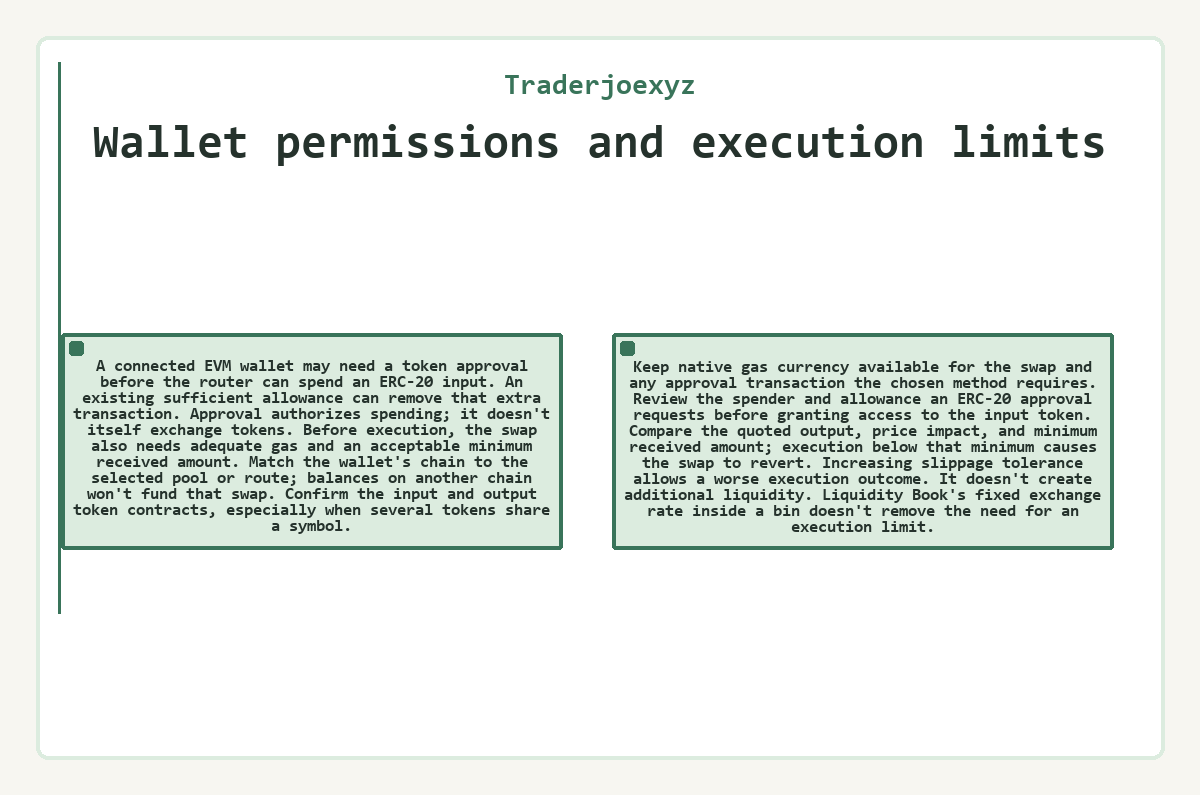
A connected EVM wallet may need a token approval before the router can spend an ERC-20 input. An existing sufficient allowance can remove that extra transaction. Approval authorizes spending; it doesn't itself exchange tokens. Before execution, the swap also needs adequate gas and an acceptable minimum received amount.
- Match the wallet's chain to the selected pool or route; balances on another chain won't fund that swap.
- Confirm the input and output token contracts, especially when several tokens share a symbol.
- Keep native gas currency available for the swap and any approval transaction the chosen method requires.
- Review the spender and allowance an ERC-20 approval requests before granting access to the input token.
- Compare the quoted output, price impact, and minimum received amount; execution below that minimum causes the swap to revert.
Increasing slippage tolerance allows a worse execution outcome. It doesn't create additional liquidity. Liquidity Book's fixed exchange rate inside a bin doesn't remove the need for an execution limit.
How do Liquidity Book positions earn swap fees?
Liquidity Book positions earn swap fees when the active trading price reaches their deposited liquidity and swaps consume it. Liquidity Book distributes the liquidity-provider share of swap fees proportionally among liquidity providers in each bin a trade uses. The LBToken receipt tracks a provider's liquidity by bin. Fee income depends on the amount traded through those bins and the fee the pool charges.
Trades also change a position's token composition. Liquidity on one side of the active price can hold only one asset, while the active bin can contain both. Price movement through a concentrated position can convert its holdings into the other asset. Its value can then fall behind holding the starting assets separately, a difference commonly called impermanent loss. Trading fees contribute to the position's return but don't ensure they cover that difference.
JOE staking and token Mill markets
The Avalanche JOE staking product distributes trading-fee-derived rewards in USDC. A staker's reward share depends on their proportion of the staking pool and the revenue allocated to it. Depositing JOE into this product doesn't create a Liquidity Book position. The staked token's price exposure remains distinct from supplying liquidity to a trading pair, and reward amounts change with fee revenue and participation.
Token Mill is LFJ's token-launch product with bonding-curve pricing. Its continuous-curve model supports trading without a separate graduation into another liquidity pool. Supply-linked pricing in those launch markets differs from liquidity providers selecting fixed-price bins in Liquidity Book. The launch mechanism describes how trading works; it doesn't establish lasting demand for the token.
What confirms a completed onchain swap?
A successful swap receipt and its token transfers confirm execution; a wallet signature or a transaction hash alone doesn't establish delivery.
The recorded recipient and output token identify where the swap's proceeds went. The received amount belongs in units of that token. Network gas reduces the gas-currency balance separately, so a wallet's overall balance change isn't the same measure as swap output. A completed approval confirms spending permission, while a successful swap confirms the exchange. An order fill also needs its own execution record, including any output deduction for platform fees.
Liquidity range changes and position maintenance
An out-of-range position retains its current token holdings while swaps stop using its liquidity. The market can return to its bins, or a provider can remove and redeploy liquidity around a different range. Rebalancing can add gas costs and trading fees if changing the token mix requires swaps. A wider distribution covers more prices, while allocating less liquidity to any single bin for the same deposit. The appropriate maintenance effort changes with price movement and liquidity placement.
LFJ's former Auto-Pools on Avalanche and Arbitrum were sunset, and their automated rebalancing no longer runs. Remaining deposits represent a proportionate share of the current asset composition, including accrued fees. An older automated position therefore shouldn't be treated as an actively maintained Liquidity Book strategy.
Before you start with Traderjoexyz
Is JOE required as an access token for ordinary swaps?
JOE isn't required as an access token for ordinary swaps. You need JOE when it's the asset you're selling or the token you're depositing into JOE staking. Trading another supported token follows that token's route and wallet requirements, including the selected chain's network fees.
Why doesn't a swapped token show up in my wallet?
A completed swap can deliver a token your wallet doesn't automatically display. Some wallets need a manual token import using its contract address. The wallet must also show the chain where the exchange executed. Importing the token makes an existing balance visible; it doesn't create a new balance or complete a pending transaction.
Can one token pair have several Liquidity Book pools?
The same token pair can have several Liquidity Book pools with different bin-step settings. Each pool has its own liquidity distribution and pricing state. The pair's name alone doesn't identify the market a swap will use or the execution conditions the selected route will encounter.
What happens to tokens when an EVM swap reverts?
A reverted EVM swap rolls back its token transfers, while the network still charges for gas used during execution. A token approval confirmed in a separate transaction before that swap can remain valid. The failed swap therefore doesn't cancel an earlier spending allowance, even though the exchange itself didn't complete.
Does disconnecting my wallet cancel ERC-20 approvals?
Disconnecting a wallet doesn't cancel existing ERC-20 approvals. The token contract stores the allowance onchain, separately from the site's connection to your wallet. Removing unused permission requires changing that allowance through a revocation transaction on the relevant chain. The spender can continue using any allowance still valid under the token's rules.
Which token pays gas for swaps on Avalanche C-Chain?
Standard wallet-submitted swaps on Avalanche C-Chain pay network gas in AVAX. That AVAX must be available on C-Chain; balances on Avalanche's other chains don't automatically cover the transaction. Pool trading fees remain a separate charge. The gas cost varies with execution and network conditions, so it isn't a fixed amount for every swap.
When can a new Liquidity Book pool's starting price cause losses?
A new Liquidity Book pool exposes deposited funds to arbitrage when its starting price disagrees with the wider market. Traders can consume the mismatched liquidity at the provider's expense. Token order and price units matter when interpreting that initial active-bin price, because the price describes one asset in terms of the other.
Are swaps on Traderjoexyz visible on the blockchain?
Ordinary onchain swaps leave public records of addresses, token movements, and transaction execution. A wallet address is pseudonymous; it doesn't inherently reveal a legal name. Links to other activity can still connect that address to an identity. Keeping wallet login details private doesn't erase those onchain records.